Adaptive world models, memory, and decisions. Explore the prototypes, manuscripts, and evidence behind each line of work.
Research at 2πarc
We study how models represent their environments, compare predictions with observations, and decide when to update.
Released prototype
Rex-WM Micro
Question. Can a small model adapt when simulated dynamics change?
Approach. Predict one-dimensional motion, observe the next state, and compare a learned correction, retained corrections, and recent-history inference.
Scope. Local CPU release. Retained corrections have shown mixed results against short-history inference in the inspected setting.
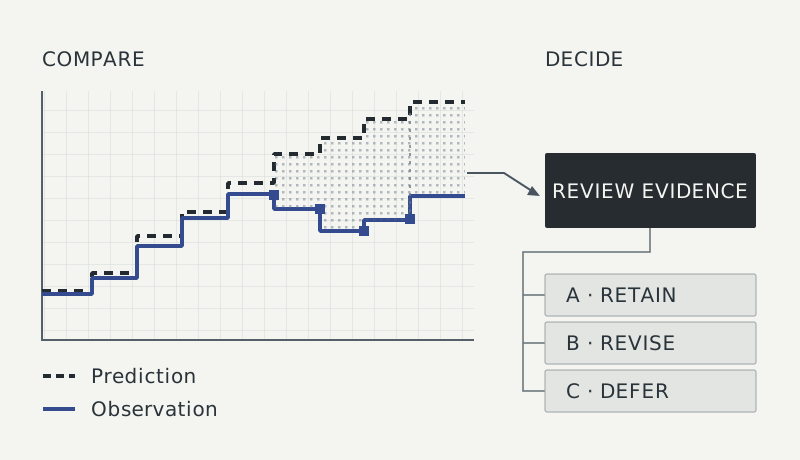
Synthetic traces illustrate how a difference between prediction and observation can prompt a review.
Adaptation and memory
Adaptive world models maintain and revise representations of changing environments. Continual learning asks how to incorporate new evidence while retaining useful earlier knowledge.
We are interested in how structured memory and explicit reasoning can work alongside learned representations. Neuromorphic and unconventional computing are longer-term exploratory directions.
Questions in the work
PREDICTION
What happens next?
Compare prediction with observation.
MEMORY
What should a model keep?
Study adaptation and earlier learning.
EVIDENCE
What justifies a change?
State assumptions and inspect the alternatives.
RESEARCH PAPERS
Manuscripts
Selected manuscripts, ordered by relevance to our current research. Read a summary here, then unlock the PDF with the shared password.
PDFs are locked.
01
World models · Adaptation
Adaptation, Recall and Inference under Sensor Noise
Aman Agarwal · Version 2 · 6 pages
Research manuscript
A controlled comparison of retained models, online corrections and recent-history inference when measurements are noisy and earlier conditions return.
Scope and version
Development experiments in one-dimensional simulation. The retained model bank does not show a consistent advantage over short-history inference.
Author affiliation: 2πarc, Rexzen.
02
World models · Model growth
Conditional Evidence for Persistent Model Growth
Aman Agarwal · Version 2 · 6 pages
Research manuscript
What evidence should a model need before adding a new mechanism? This paper separates prediction errors, diagnostic evidence and lasting changes to model structure.
Scope and version
Theory under stated observation laws, with reconstructed synthetic results. The saved studies were inspected rather than independently rerun.
Author affiliation: 2πarc, Rexzen.
03
EOS · World model architecture
Evidence-Gated Causal World Models for Continual General Intelligence
Aman Agarwal · Complete portfolio extract · 5 pages
Research manuscript
A proposed architecture separating high-capacity prediction from the evidence that permits persistent change. It connects world models, memory, active experiments and structural governance.
Scope and version
An architecture hypothesis, with component evidence and proposed falsification experiments. The complete system remains unimplemented. The complete five-page paper is extracted from portfolio pages 11 to 15, including its references.
Author affiliation: Sonne Systems.
04
EOS · Evidence and governance
Dual Governance for Continual Agents: Separating Reversible Information Acquisition from Persistent Self-Modification
Aman Agarwal · Complete portfolio extract · 3 pages
Research manuscript
A typed interface that gives reversible information gathering and persistent model changes different authority. Evidence for an observation cannot automatically permit a lasting mutation.
Scope and version
Formal analysis and three constrained reference studies with supplied binary mechanisms. This does not establish autonomous structural discovery or a learned open-world model. The complete three-page paper is extracted from portfolio pages 8 to 10, including its references.
Author affiliation: Sonne Systems.
05
World models · Partial observation
Consequence-Certified State Refinement and Anytime False-Birth Control in POMDP World Models
Aman Agarwal · Supplied manuscript · 7 pages
Research manuscript
When a model cannot see the full state, which histories can it safely merge? The paper studies consequences of actions and the evidence needed to create new structure.
Scope and version
Formal conditions and separate component studies. The experiments do not establish a complete POMDP agent.
Author affiliation: Sonne Systems.
06
World models · Identifiability
When Is Structural Novelty Identifiable? Consequence Separation and Anytime-Valid Model Growth
Aman Agarwal · Supplied manuscript · 6 pages
Research manuscript
A mathematical account of when available observations and interventions can distinguish a new mechanism from a known one.
Scope and version
Results depend on finite, supplied mechanism classes and exact predictive laws. These assumptions limit transfer to learned real-world systems.
Author affiliation: Sonne Systems.
07
Decision systems · Consequence auditing
Counterexamples, Not Certificates: Fresh Evidence for Learned Consequence-Query Auditing
Aman Agarwal · Complete portfolio extract · 3 pages
Research manuscript
A learned auditor can find a context where a model change causes harm. Fresh evidence checks that counterexample, while an unsuccessful search leaves the question open.
Scope and version
Synthetic auditing study with a fixed-design result. The complete three-page paper is extracted from portfolio pages 5 to 7, including its references.
Author affiliation: Sonne Systems.
08
Decision systems · Goals
Goal Endorsement Under Uncertain Authorship: Identification, Regret, and the Cost of Asking Again
Aman Agarwal · Revised manuscript · 22 pages
Research manuscript
A goal's origin and its present value are different questions. This paper studies ambiguous reports, the cost of asking again and decisions under uncertain endorsement.
Scope and version
Formal analysis, synthetic comparisons and an exploratory public-data audit. The data provide no gold standard for a person's true endorsement.