Aero is the software we are building today. Our longer-term research considers how its memory and permissions could support wearable, spatial, and neural interfaces.
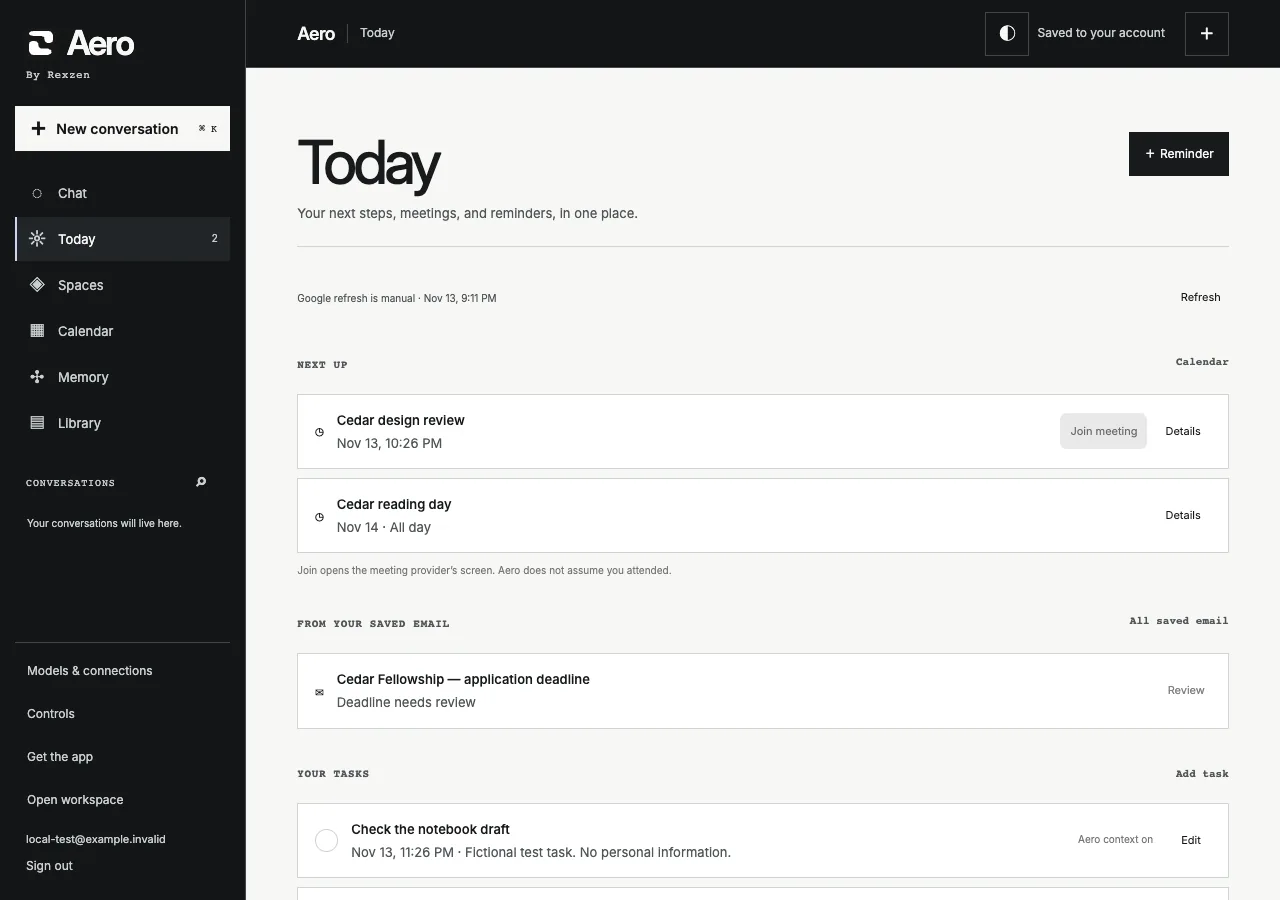
Aero keeps conversations across model switches. Users can edit saved memory, and Aero can select relevant records for each request.
Approved actions can turn a request into a task or reminder. We are building this layer around clear permissions so future interfaces can use the same context with the user’s consent.
Aero interface with fictional example information.
Aero devices
Explore the screened Locket, the slimmer Aero Glasses and Aero Signal's non-invasive EEG fit research. The original voice bench and Desk Dock are available below.
A compact voice interface for requests like setting a reminder while your hands are busy.
Enclosure
32 × 44 × 10.4 mm
Cover clearance
0.20 mm per side
Strap opening
4 mm diameter
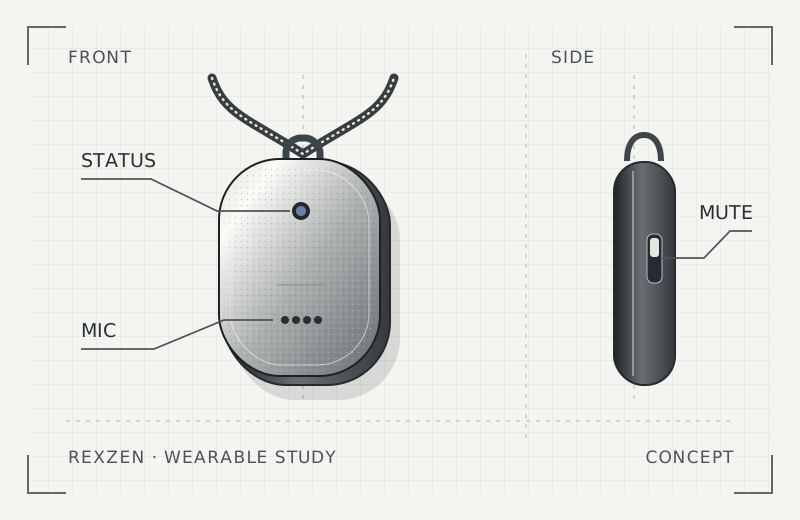
A metallic face surrounds a recessed request button, a recording light, and an independent mute control. Two separate acoustic ports sit near the lower edge.
A removable clip anchors at the strap opening. A separate split ring lets the Locket hang from a keychain. Remove either mount before seating the Locket in the Dock.
The wearable design puts a physical mute and a visible recording indicator on the device. A real implementation would also need clear authorization, retention controls, and consent for recording others.
Physical validation
The Locket and Dock geometry is ready for a fit print. Print tolerances, electronics, acoustic performance, retention, and water resistance need physical testing.
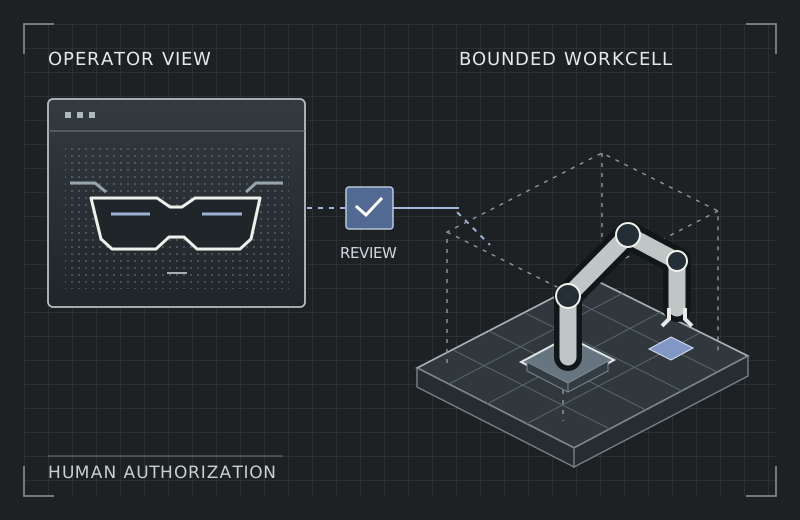
Smart glasses could give Aero a spatial view, and a world model could track relevant objects, relationships, and changes. A separate, authorized control path could connect that understanding to compatible machines.
One research scenario is a person at home using glasses and a voice interface to observe a remote workspace and supervise a robot. The person would see the proposed action, authorize it, and retain the ability to stop it.
Conceptual workcell with a review step between the operator view and the proposed action.
Laboratories
Observe an experiment or manipulate compatible instruments from another location within a defined operating envelope.
Factories
Inspect equipment, monitor a process, or supervise a specific manipulation that can tolerate the connection’s delay.
Accessibility
Explore alternative interfaces for people who could benefit from operating a compatible machine or environment at a distance.
Reliable teleoperation depends on perception, latency management, precise control, safe stopping, and hardware integration. Each task would require validation in its operating environment.
Long-term exploration
Neural interfaces
We want to investigate whether a deliberately learned neural signal could help a person select an action in software or operate a compatible assistive device.
Human intention
Neural interface
Intelligent interpretation
Authorized action
Theoretical interaction pathway for a bounded digital or robotic action.
Non-invasive interfaces would be an initial area to explore. Invasive approaches would require regulated research partners, ethics oversight, and explicit participant consent.
Potential uses include accessibility, assistive technology, and specialized workflows. Each would need evidence for reliability, safety, and the ability to withdraw consent.
Current work
Explore Aero and the prototypes and manuscripts from our adaptive world model research.